To effectively remove pet stains and odors from area rugs, you need to act quickly with enzyme-based cleaners that break down urine proteins, followed by thorough extraction to reach the rug backing and padding where odors hide. At 24 Hours Long Island Carpet Cleaning, we’ve treated thousands of pet-damaged rugs across Long Island since 2009, and the key difference between temporary masking and permanent removal is treating the entire contaminated area not just the surface stain you can see.
If you’re reading this, you’re probably dealing with one of these frustrating situations: your dog or cat had an accident on your expensive Persian rug, there’s a persistent urine smell you can’t get rid of no matter how many times you’ve cleaned the spot, old stains from previous pets are showing through, or you’ve just moved into a home with rugs that smell like the previous owner’s animals. The good news? Most pet damage is reversible if you address it correctly. The bad news? Most DIY attempts actually make things worse by setting stains deeper or spreading contamination.
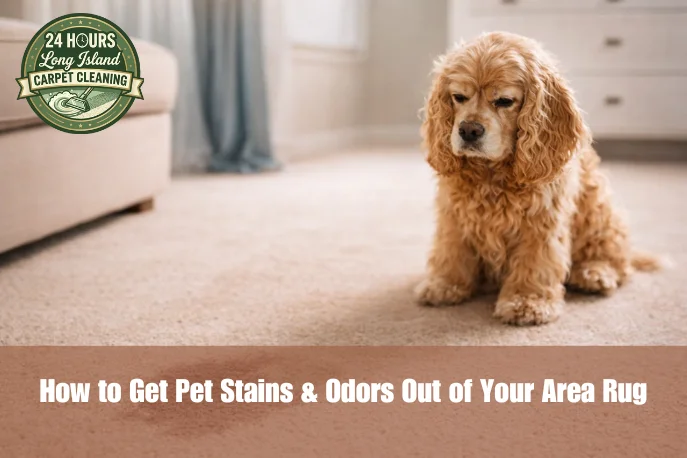
Why Pet Stains Are Different (And Why They’re So Hard to Remove)
Here’s what makes pet stains especially urine so challenging compared to wine, coffee, or food spills:
Urine doesn’t just sit on the surface. It soaks through the pile, through the backing, and often into the padding underneath. When you see a 4-inch stain on top, there’s typically an 8–12 inch contamination zone below.
Urine contains uric acid crystals that bond to rug fibers. These crystals are NOT water-soluble, which is why soap and water don’t work. They need enzyme treatments to break down.
Bacteria grows in contaminated areas, creating that ammonia smell that gets worse in humid weather or when the rug gets wet.
Male cat spray is the worst it’s concentrated marking behavior with hormones that create particularly stubborn odors.
Old stains are harder than new ones because the longer urine sits, the more deeply it bonds to fibers and oxidizes (turning yellow or brown).
We serve pet owners throughout Long Island from Floral Park to Freeport, Garden City to Great Neck, Mineola to Montauk and pet accidents on area rugs are one of our most common calls. The difference between success and failure comes down to using the right products and techniques for the specific type of pet damage.
The Critical First 24 Hours: What to Do IMMEDIATELY
If the accident just happened (you caught your pet in the act or the spot is still wet), here’s your emergency response:
Step 1: Blot, Don’t Rub (First 5 Minutes)
Grab clean white towels or paper towels white so you can see what you’re pulling out, and to avoid dye transfer.
Press firmly on the wet area to absorb as much liquid as possible. Stand on the towel if needed to really push moisture up.
Replace towels and repeat until towels come up barely damp. You want to remove 70–80% of the urine before it soaks deeper.
DO NOT RUB OR SCRUB this pushes urine deeper into fibers and spreads it to a larger area.
Step 2: Enzyme Treatment (Next 10 Minutes)
Use an enzyme-based pet cleaner not soap, not vinegar, not baking soda. Enzymes break down the proteins in urine. Products like Nature’s Miracle, Rocco & Roxie, or Simple Solution work if used correctly.
Apply generously you need to reach as deep as the urine went. If the urine soaked through, the enzyme treatment needs to soak through too.
Let it sit for the time specified on the bottle (usually 10–15 minutes). The enzymes need contact time to work.
Blot again to remove excess enzyme cleaner and dissolved urine.
Step 3: Extract or Call Professionals
For small, fresh accidents on synthetic rugs, home treatment might work. But if the stain is:
- On a wool, silk, Persian, or Oriental rug
- Larger than 6 inches across
- Soaked through to the backing
- From a repeat offender (same spot multiple times)
- Already starting to smell
- More than 24 hours old
Call us immediately at (516) 894-2919. Every hour that passes makes complete removal harder.
What NOT to Do (Common Mistakes That Make Things Worse)
❌ DON’T use vinegar and baking soda This is popular on Pinterest but creates problems. The acid-base reaction looks impressive (lots of fizzing) but doesn’t actually remove urine. Worse, it can set stains and leave residue that attracts more dirt.
❌ DON’T use steam cleaners or hot water Heat sets protein-based stains (like urine) permanently. If you use a carpet cleaner with hot water on pet urine, you’ve just cooked the proteins into the fibers.
❌ DON’T just clean the surface The visible stain is only part of the problem. The smell comes from contamination below the surface that you can’t see.
❌ DON’T use scented products to mask odor Febreze and similar products don’t remove urine they just cover the smell temporarily. Plus, now you have urine AND perfume chemicals in your rug.
❌ DON’T scrub or use a brush This damages rug fibers, especially on hand-knotted Persian and Oriental rugs where you can actually separate knots and cause unraveling.
❌ DON’T wait to see if it gets better Urine doesn’t evaporate and disappear. It bonds deeper, the smell gets worse, and bacteria growth increases. The longer you wait, the harder (and more expensive) removal becomes.
Our Professional Pet Stain & Odor Removal Process
When you bring a pet-damaged rug to our facility at 19 Violet Ave in Floral Park (or we pick it up from your home anywhere in Nassau or Suffolk County), here’s what happens:
Step 1: UV Light Inspection
We use ultraviolet blacklight to identify ALL contaminated areas not just the visible stains. Urine glows under UV light, revealing the full extent of damage. Often, a rug with 2–3 visible stains actually has 10+ contaminated spots.
This is critical for Persian rugs, Oriental rugs, and wool rugs where previous owners may not have disclosed pet damage.
Step 2: Thorough Dusting
Before wet cleaning, we remove dry soil and debris. Pet hair, dander, and dirt need to come out first or they’ll turn to mud during washing.
Step 3: Enzyme Pre-Treatment
We apply professional-grade enzyme solutions specifically formulated for the type of contamination (dog urine, cat urine, feces, vomit each requires different enzymes).
These products are stronger than consumer versions and we know exactly how long to leave them on each rug type without causing dye bleeding or fiber damage.
Step 4: Submersion Washing
For durable rugs, we do complete submersion cleaning meaning the entire rug is soaked in temperature-controlled water with specialized pet-safe detergents. This is the ONLY way to flush out urine that’s penetrated to the backing.
Your home carpet cleaning equipment can’t do this. Neither can in-home rug cleaning. The rug must be removed and cleaned in a facility.
Step 5: Neutralizing Treatment
After enzyme and detergent washing, we apply pH-balancing neutralizers to ensure all urine crystals are broken down and all cleaning agents are removed.
Step 6: Extraction & Rinsing
Multiple rinse cycles with our specialized rug washing equipment remove all contamination and cleaning products. We literally flush urine out of the rug rather than just diluting it.
Step 7: Odor Elimination (If Needed)
For severe cases, we use oxidizing treatments that chemically neutralize odor molecules rather than masking them. This is true odor removal, not just covering smells.
Step 8: Climate-Controlled Drying
Rugs dry flat or on racks in controlled conditions. Proper drying prevents mold and mildew that can develop if pet-damaged rugs dry too slowly.
Step 9: Final UV Inspection
Before returning the rug, we check again under UV light to confirm all contamination is gone.
Typical turnaround: 7–14 days depending on severity and rug type.
Pet Stain & Odor Removal by Rug Type
| Rug Type | Treatment Difficulty | Success Rate | Special Considerations | Average Cost |
|---|---|---|---|---|
| Synthetic (polypropylene, nylon) | Easy | 95%+ | Most forgiving; handles aggressive treatment | $150–$300 |
| Wool (natural fiber) | Moderate | 85–95% | Absorbs urine deeply; requires thorough flushing | $200–$450 |
| Persian/Oriental (hand-knotted) | Difficult | 80–95% | Dye bleeding risk; needs expert care | $300–$700+ |
| Silk | Very Difficult | 70–85% | Cannot use aggressive treatments; delicate process | $400–$1,000+ |
| Antique/Vintage | Extremely Difficult | 60–80% | May need repair first; success depends on condition | $500–$1,500+ |
| Jute/Sisal | Difficult | 70–85% | Cannot submerse; limited moisture cleaning only | $200–$400 |
Success rates drop significantly for:
- Old stains (6+ months)
- Repeated contamination in same spot
- Cat spray (vs. regular cat or dog urine)
- Rugs that were previously “cleaned” with wrong products
Synthetic Rugs
These are the easiest. Polypropylene and nylon don’t absorb urine as readily as natural fibers, and they can handle aggressive enzyme treatments and hot water extraction without damage.
If you have pets and want area rugs, synthetic is your friend.
Wool Rugs
Wool rug cleaning with pet damage is our specialty. Wool is a protein fiber just like the proteins in urine—which means it absorbs and holds urine more than synthetic materials.
The good news: wool can be thoroughly cleaned without damage. The bad news: it requires professional submersion washing. Home treatments will never fully remove urine from wool.
Persian & Oriental Rugs
Pet stain cleaning on Persian rugs requires expertise because:
Natural dyes can bleed when exposed to enzyme cleaners or extended moisture. We test every colored area first.
High knot counts mean more surface area for urine to penetrate. A 200-knot Persian has far more absorbent surface than a 50-knot rug.
Value concerns a $5,000 rug requires extra care to avoid damage that could cost more than the cleaning.
We’ve successfully treated pet-damaged Persians from homes throughout Great Neck, Hewlett, and Woodmere. The key is catching damage early and using facility-based submersion cleaning rather than attempting in-home treatment.
Silk Rugs
Silk rug cleaning with pet damage is high-risk. Silk loses strength when wet, so extended enzyme treatments and submersion washing require extreme care.
For valuable silk rugs, we’re honest: sometimes the risk of cleaning damage outweighs the benefit of stain removal. We’ll give you realistic expectations before starting work.
Antique Rugs
Antique rug cleaning with pet contamination often requires repair work first. If foundation threads are weak, we need to stabilize them before wet cleaning.
We’ve had clients with 100+ year old rugs from estate sales that had decades of pet damage. Some are salvageable, others aren’t. We assess honestly before proceeding.
DIY Treatment for Fresh, Small Stains (Use at Your Own Risk)
If you’re determined to try home treatment before calling us, here’s the ONLY approach that has any chance of working:
What You Need:
- Enzyme cleaner (Nature’s Miracle, Rocco & Roxie)
- White towels or clean rags
- Fan for drying
- Patience
Process:
- Blot immediately with white towels until barely damp
- Apply enzyme cleaner generously to match depth of urine penetration
- Wait 15 minutes for enzymes to work
- Blot again to remove dissolved urine and excess cleaner
- Rinse with cold water by pouring small amounts and blotting (if the rug can handle it—NOT for silk or antique rugs)
- Extract as much moisture as possible use wet/dry vacuum if you have one
- Air dry completely with fans running (24–48 hours)
Check after drying: Smell the area. If there’s ANY odor remaining, home treatment failed and you need professional help.
Success rate: Maybe 30–40% for fresh accidents on synthetic rugs. Near 0% for:
- Wool, silk, or natural fiber rugs
- Accidents older than 24 hours
- Repeat contamination
- Cat spray
- Large stains (over 6 inches)
Why Quick Action Matters: The 24-Hour Rule
Within 24 hours: Fresh urine hasn’t fully bonded to fibers. Enzymes can still break it down relatively easily. Odor bacteria haven’t fully established. Success rate: 90%+
24 hours to 1 week: Urine has started crystallizing. Bacteria are growing. Odor is developing. More aggressive treatment needed. Success rate: 70–85%
1 week to 1 month: Crystals are bonding deeply. Stains are oxidizing (turning yellow/brown). Bacterial colonies established. Success rate: 60–75%
Over 1 month: Permanent dye damage possible. Deep crystallization. May require multiple treatment cycles. Success rate: 40–60%
Over 6 months: Often permanent damage. May be able to reduce odor but not eliminate it completely. Stain removal may be impossible without damaging fibers. Success rate: 30–50%
We get calls from homeowners in Valley Stream, Lynbrook, and Long Beach who’ve been living with pet odors for months or years, hoping they’ll “air out.” They don’t. They get worse. And by the time they call us, what could have been a $200 cleaning is now $500+ with uncertain results.
Special Situations: When Pet Damage Requires Extra Steps
Multiple Pets or Repeat Offenders
If your dog has peed on the same rug multiple times, or you have multiple pets using it as a bathroom, the contamination goes beyond normal treatment.
We often recommend:
- Replacing padding underneath (if applicable)
- Treating the floor below the rug
- Enzyme treatment followed by sealing to prevent re-marking
- Sometimes, retiring the rug and starting fresh (we know that’s hard to hear, but sometimes it’s reality)
Male Cat Spray
This is concentrated marking behavior with hormones that create incredibly stubborn odors. Even after professional cleaning, there’s about a 20% chance some odor returns in high humidity or if the rug gets wet again.
For valuable rugs with cat spray, we recommend:
- Multiple enzyme treatment cycles
- Extended submersion washing
- Oxidizing odor treatments
- Sealing after cleaning
Feces or Vomit
Pet stain cleaning for solid waste or vomit is actually easier than urine IF you remove it quickly. The key is:
- Scrape up solids without grinding them in
- Treat remaining stain like any protein stain
- Enzyme cleaner for proteins, targeted spot removal
But if it sits for hours and soaks in, or if your pet has digestive issues causing acidic vomit, that’s when you need professional help.
Old Stains from Previous Owners
Buying a home with pet-damaged rugs? We’ve cleaned rugs from estate sales and home purchases throughout Huntington, Smithtown, and Bay Shore where new owners discover (via smell) that the previous owners had pets.
UV light inspection reveals the full extent, and we give realistic assessments: “This rug is salvageable” vs. “You should replace this” vs. “This is worth the investment to clean given its value.”
Prevention: What to Do If You Have Pets & Area Rugs
Train pets properly this is obvious but worth saying. House-training reduces accidents dramatically.
Use rug pads they create a moisture barrier and make it easier to pull the rug up quickly after accidents.
Keep enzyme cleaner on hand have it ready before you need it.
Clean accidents immediately the 24-hour rule is real.
Place rugs strategically don’t put your $3,000 Persian in your puppy’s favorite room.
Consider synthetic rugs for high-risk areas save the wool and silk for rooms pets don’t access.
Schedule regular professional cleaning even without visible stains, pet dander and oils build up. Annual or biannual area rug cleaning keeps rugs fresh.
Address health issues if your pet is having frequent accidents, see a vet. Medical issues cause many “behavioral” problems.
Related Services You Might Need
Pet owners with area rugs usually also need:
- Wall-to-wall carpet cleaning for pet traffic and accidents
- Upholstery cleaning for couches where pets sleep
- Mattress cleaning if pets sleep on beds
- Odor removal for entire rooms affected by pet smells
We handle all of it, and bundling services saves money.
When to Give Up on a Rug
We hate saying this, but sometimes a rug is beyond saving:
Replace if:
- Multiple years of repeated contamination
- Severe structural damage (rotted backing, separated knots)
- Cost of cleaning exceeds 50% of replacement value
- Health concerns (severe mold from moisture damage)
- Cleaning attempts have failed multiple times
We’ll be honest with you. If a rug isn’t worth saving, we’ll tell you before you spend $500 trying to resurrect something that should be replaced.
Cost Expectations for Professional Pet Stain & Odor Removal
Light pet damage (1–2 fresh accidents, small area):
- Small rug (4×6): $150–$250
- Medium rug (6×9): $250–$400
- Large rug (9×12): $400–$600
Moderate pet damage (multiple old stains, moderate odor):
- Small rug: $200–$350
- Medium rug: $350–$550
- Large rug: $550–$800
Severe pet damage (extensive contamination, strong odor, multiple cleaning cycles needed):
- Small rug: $300–$500
- Medium rug: $500–$800
- Large rug: $800–$1,200+
These prices include:
- Pickup and delivery
- UV inspection
- Complete submersion washing
- Enzyme treatments
- Odor neutralization
- Climate-controlled drying
Not included:
- Padding replacement (if needed)
- Structural repairs to rug damage
- Floor treatment under the rug
We provide written quotes after inspection so there are no surprises.
Why Choose 24 Hours Long Island Carpet Cleaning for Pet Damage?
We’re pet owners too we understand the frustration and embarrassment of pet accidents. No judgment, just solutions.
Facility-based cleaning we don’t just clean rugs in your home with a wand. We remove them to our location at 19 Violet Ave in Floral Park for proper submersion treatment.
UV light inspection we find ALL contamination, not just visible stains.
Professional-grade enzymes stronger than consumer products and properly matched to contamination type.
15+ years experience we’ve seen every type of pet damage imaginable across Nassau and Suffolk counties.
Honest assessments if a rug isn’t salvageable, we’ll tell you before you waste money.
Satisfaction guarantee if odors return within 30 days, we’ll re-treat at no charge.
Serving Pet Owners Throughout Long Island
We pick up and deliver pet-damaged rugs from:
Nassau County: Floral Park, Garden City, Great Neck, Mineola, Rockville Centre, Valley Stream, Long Beach, Freeport, Hewlett, Woodmere, Glen Cove, and all surrounding areas
Suffolk County: Huntington, Smithtown, Bay Shore, Babylon, Patchogue, Islip, Ronkonkoma, Riverhead, Southampton, East Hampton, and beyond
We’ve handled pet damage in everything from beachfront homes dealing with sandy dog paws to luxury estates with pristine Persian collections that suffered one unfortunate accident.
Don’t Wait—Every Day Makes It Harder
Pet stains and odors don’t improve with time. The urine crystals bond deeper, bacteria multiply, odors intensify, and stains oxidize. What’s treatable today might be permanent damage next month.
Call us NOW at (516) 894-2919 or visit 24hourcarpetcleaning-longisland-ny.net to schedule your rug pickup.
We’ll inspect it, give you an honest assessment, provide a detailed quote, and in most cases return a rug that looks and smells like the accident never happened.
Your rug (and your nose) will thank you.
